
Why Most Public Decisions Fail at the
- Cody Jones
- Apr 17
- 3 min read

Implementation Stage
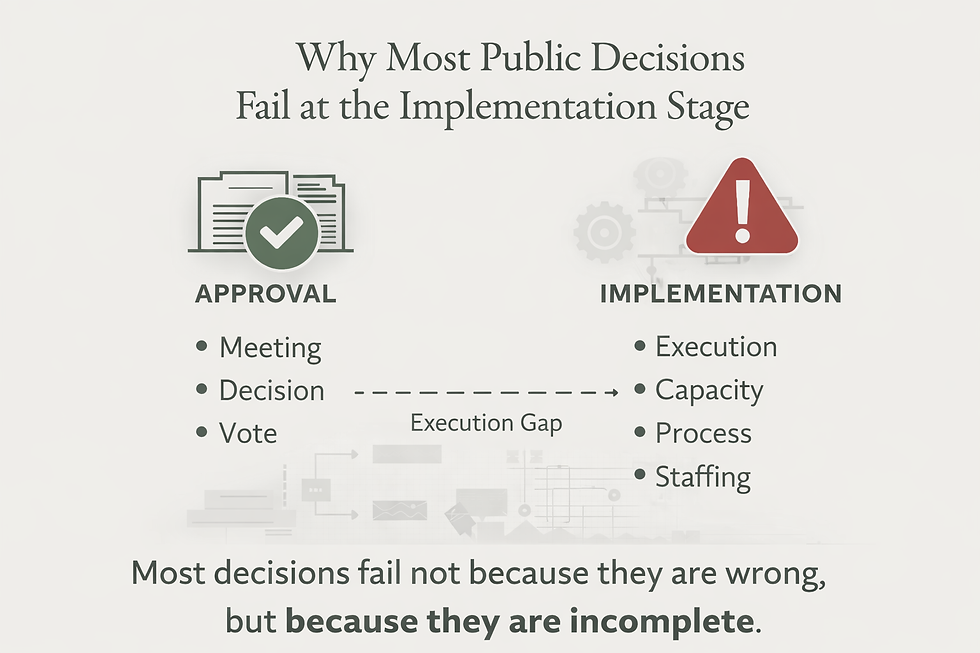
Decisions rarely fail because they are wrong.
They fail because they are incomplete.
In public-sector environments, there is often a clear emphasis on reaching a decision. Meetings are held, proposals are reviewed, and votes are taken. Once approval is granted, the process is treated as finished.
In reality, approval is not the conclusion of a decision.It is the beginning of execution.
Without a clearly defined implementation plan, even well-intentioned decisions introduce unnecessary risk.
The Gap Between Approval and Execution
Most decision-making processes focus heavily on whether something should be done.
Far less attention is given to how it will actually be carried out.
This gap creates a predictable pattern:
A decision is approved based on high-level reasoning
Supporting details are assumed rather than demonstrated
Implementation is deferred to a later stage
Operational challenges emerge after the decision is already committed
At that point, options are limited. Adjustments become reactive instead of strategic.
What “Incomplete” Looks Like
An incomplete decision is not always obvious at the surface level.
It often appears structured and justified. The problem is not the existence of a decision—it is the absence of a complete framework behind it.
In practice, this typically includes:
1. No Integrated Implementation Plan
Decisions are approved without a single, cohesive plan that connects all operational elements.
Instead, planning is fragmented across departments or deferred entirely.
2. Assumed Capacity
There is an implicit assumption that existing systems—facilities, staffing, logistics—can absorb change.
Without detailed analysis, these assumptions introduce strain that is only discovered after implementation begins.
3. Undefined Operational Impact
Day-to-day execution is not clearly mapped.
Key questions remain unanswered:
How will this function on a daily basis?
What changes for staff?
What changes for the people directly affected?
Without these answers, the decision exists only at a conceptual level.
4. Lack of Demonstrated Readiness
Readiness is treated as an outcome of approval rather than a prerequisite.
In reality, readiness should be demonstrated before a decision is finalized—not developed afterward.
Why This Happens
This pattern is not the result of negligence. It is structural.
Public decisions operate under pressure:
Time constraints
Budget concerns
Political considerations
Community expectations
These pressures encourage movement toward a decision, sometimes at the expense of complete preparation.
The result is a process that prioritizes resolution over readiness.
The Risk of Moving Forward Too Early
When implementation details are not fully developed, risk is introduced in predictable ways:
Operational strain on existing systems
Increased burden on staff
Inefficient allocation of resources
Reduced quality of service or experience
Loss of public confidence
These risks are rarely theoretical. They emerge quickly once execution begins.
At that stage, correcting them is significantly more difficult—and more costly—than addressing them beforehand.
What a Complete Decision Looks Like
A decision is complete when it is supported by a clearly demonstrated implementation framework.
At a minimum, this includes:
Operational Planning
A defined structure for how the decision will function in practice
Capacity Alignment
Clear evidence that systems can absorb the change
Staffing and Resource Allocation
Adjustments that reflect actual demand
Logistical Execution
Day-to-day processes mapped and understood
Demonstrated Readiness
Evidence that the system is prepared to operate under the new structure
A complete decision does not eliminate risk.It reduces avoidable risk.
Reframing the Standard
The standard for decision-making should not be:
“Is this the right idea?”
It should be:
“Is this ready to be implemented?”
That distinction changes everything.
It shifts the focus from approval to execution, from intent to outcome.
Final Thought
Most public decisions do not fail because they lack justification.
They fail because they move forward without a fully demonstrated operational foundation.
A decision that cannot be clearly implemented is not yet complete.
And incomplete decisions carry risk that does not need to exist.
About Ironwood Policy & Risk
Ironwood Policy & Risk provides structured evaluation of public decisions, operational readiness, and implementation risk.
Our focus is direct: identify gaps early, assess real-world constraints, and ensure that decisions are supported by more than intent before they move forward.


Comments