
Operational Readiness: The Step Most Organizations Skip
- Cody Jones
- Apr 19
- 3 min read


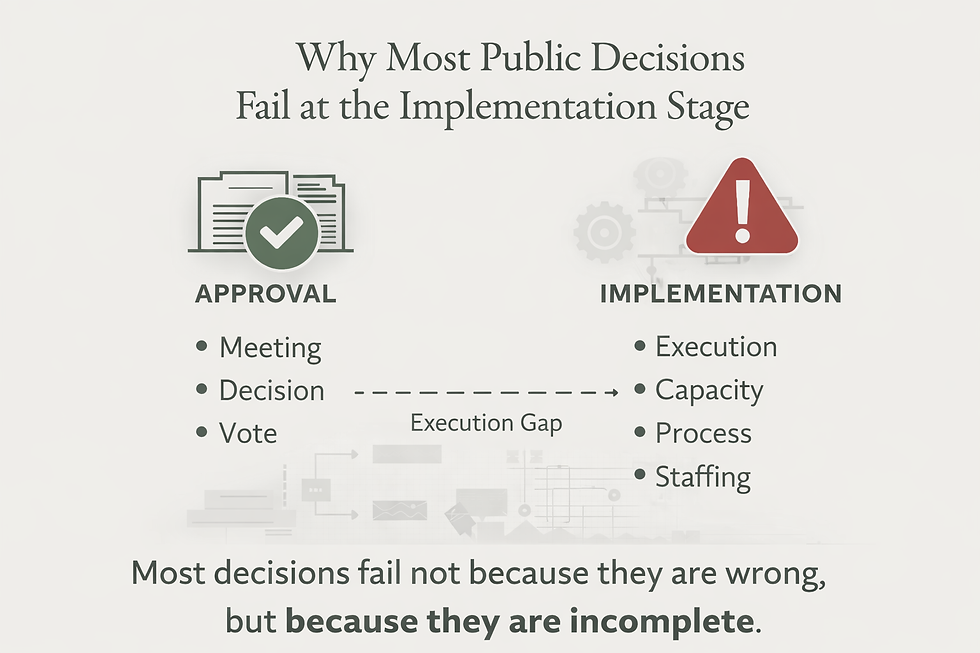
Most decisions don’t fail at the moment they’re made.
They fail the moment they’re implemented.
The reason is simple:Operational readiness is often assumed, not demonstrated.
In many organizations—especially in public-sector environments—there is a clear process for evaluating whether a decision should be made. There are fewer structured processes for determining whether that decision is ready to be executed.
That gap introduces risk long before implementation begins.
What Operational Readiness Actually Means
Operational readiness is not a concept.It is a condition.
It answers a straightforward question:
Can this decision function in the real world, under real conditions, on day one?
If that question cannot be clearly answered, the decision is not ready.
At a minimum, operational readiness requires alignment across four core areas:
Staffing
Capacity
Logistics
Execution
If any one of these is undefined or unsupported, the system is not ready to absorb change.
Where Readiness Breaks Down
Operational readiness is often treated as something that will be resolved after approval.
In practice, that leads to predictable gaps.
1. Staffing Does Not Scale With Demand
Changes are introduced without corresponding adjustments in staffing structure.
The assumption is that existing personnel can absorb new responsibilities or increased load.
In reality, this leads to:
Increased strain on staff
Reduced efficiency
Degraded service quality
Staffing is not a static input. It must scale with the system it supports.
2. Capacity Is Assumed, Not Verified
Physical and operational capacity is often evaluated at a high level, not at the point of execution.
There is a difference between:
Available space
Functional capacity
Without detailed analysis, systems appear sufficient on paper but fail under real conditions.
3. Logistics Are Underspecified
Logistics are where decisions become real.
Transportation routes, scheduling, movement patterns, and daily workflows define how a system operates.
When logistics are not clearly mapped:
Inefficiencies emerge immediately
Bottlenecks form quickly
Small issues compound into larger problems
Logistics cannot be abstract. They must be defined.
4. Execution Is Deferred
Execution is often treated as a downstream responsibility.
The decision is made, and implementation is left to operational teams to figure out.
This creates a disconnect:
Decision-makers assume feasibility
Operators inherit complexity
A system that requires improvisation to function is not operationally ready.
Why Organizations Skip This Step
Operational readiness is often overlooked because it is difficult.
It requires:
Cross-functional coordination
Detailed planning
Willingness to slow the decision timeline
In environments under pressure—whether financial, political, or organizational—there is a tendency to prioritize resolution over preparation.
The result is a decision that is approved quickly but implemented poorly.
What Readiness Looks Like in Practice
A decision is operationally ready when its execution is clearly defined, not assumed.
This includes:
Defined Staffing Model
Roles, responsibilities, and load are aligned with actual demand.
Verified Capacity
Systems are evaluated based on how they function under real conditions—not theoretical limits.
Mapped Logistics
Day-to-day operations are structured, predictable, and testable.
Execution Framework
There is a clear plan for how the system will operate immediately upon implementation.
Operational readiness is not perfection.
It is clarity.
The Cost of Skipping Readiness
When operational readiness is not established before implementation, the system absorbs the cost.
That cost appears as:
Staff burnout
Inefficient operations
Resource misallocation
Declining performance
Loss of confidence in leadership
These outcomes are often attributed to execution failure.
In reality, they are planning failures.
Reframing the Process
Operational readiness should not follow a decision.
It should precede it.
The correct sequence is:
Evaluate the decision
Define the implementation
Demonstrate readiness
Approve the action
Reversing that order introduces avoidable risk.
Final Thought
A decision that cannot be clearly executed is not ready to be approved.
Operational readiness is not a detail.
It is the foundation that determines whether a decision succeeds or fails.
About Ironwood Policy & Risk
Ironwood Policy & Risk evaluates operational readiness, implementation risk, and decision-making frameworks across public and private-sector environments.
Our focus is direct: ensure that decisions are supported by real-world execution before they move forward.


Comments